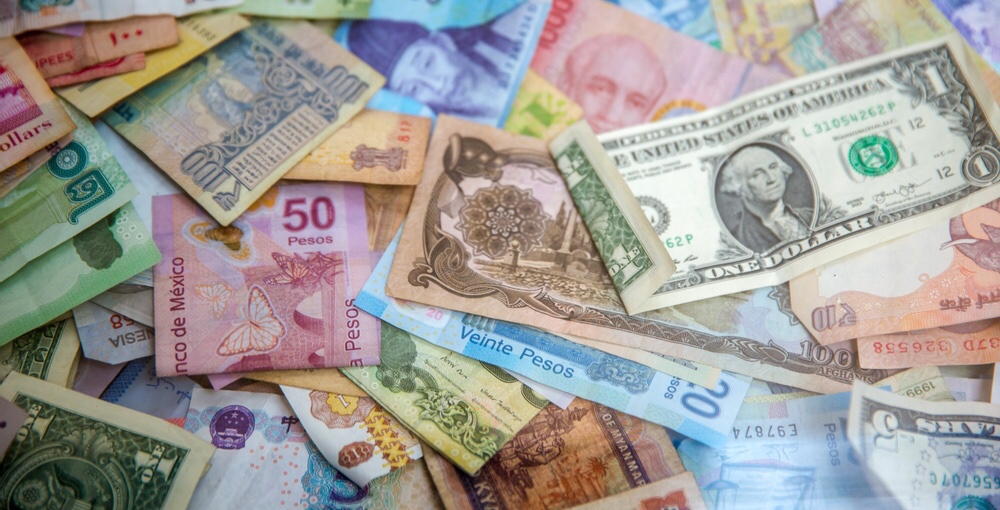
I think we’re all quick to jump the answer of what exactly money is. Let’s take a step back and start with a little bit of history on the science of money. Before currencies, civilizations were okay with producing and harvesting for one another. In small and controlled communities people would barter (original form of exchange) for what they needed and the payments or receipts upon transaction were easily remembered. Keeping tabs on the exchanges, in a way for the public (with stones or a big wall) to see was the only way of making record for who had been paid and who was still owed. However, when communities began to advance exponentially the accounting books of the exchanges became too much to maintain. It was only inevitable for the introduction of debt upon the same time as money creation.
There is a common phrase that goes, “He who owns the gold makes the rules”. Having money meant power. Power could get you a lot of gold. The Monarchy system began to mine coins from precious metals, and because it had intrinsic value it could be used to facilitate global trade. However, tensions emerged and shortly after the birth of the system greed made its way in and began to outweigh the natural laws of supply & demand, as well as the “greater good”.
Sovereignty realized that by clipping down the coins (coin shaving) or adding cheaper base metals into the mixture, that would provide them with the opportunity to create money by circulating debased currency worth less than face value throughout the economy. Too much demand chasing too few goods can cause huge surges in inflation. It was the early Chinese rulers who introduced the idea of storing their gold coins back in the palace while issuing I.O.U certificates as a substitute to the nations. Although the paper did not hold any intrinsic value, people still trusted it was worth what it said it was worth. A full backing of faith and trust in the government through issuance of fiat paper.
Money can represent various forms of value. In the end, it is a medium of exchange. A tool to barter with which happens to be the most liquid asset in the financial markets. There were five aspects that had to be met for classification as an asset:
- Divisible
- Durable
- Portable
- Recognizable
- Scarce
Money used to be salt, cattle, beans, stones and other forms of commodities. Until finally some kind of consensus was found on gold followed by fiat currency. Gold was the most scarce, as it was expensive and very labour intensive. It was the best tool for moving value across time, but too heavy for moving value across space. Therefore, the augmented technological failure in gold called for a change to paper currency, which is now redeemable for time.
The “get rich tomorrow strategy” has been one of the most popular trends for the last decade. A “get rich quick” scheme that bears little to no financial education is like trying to build a house on a weak foundation. Instant gratification is the deadweight that drives this crowd. Most people underestimate what they can do in the long term and overestimate what they can do in the short-term. “Two percent of the people think; three percent of the people think they think; and ninety-five percent of the people would rather die than think” George Bernard Shaw.
The rich don’t work for money, instead they have their money work for them. They mask most of their wealth using vehicles such as corporations, trust funds, real estate, stocks, bonds, assets etc. to protect themselves from creditors. For example; a corporation can pay expenses before taxes unlike an employee can. A corporation: earns — spends what it can — is taxed on what is left. The employee: earns — gets taxed — followed by bills/expenses — and whatever left over is the take home for the keep. This is one of the many reasons why the rich pay much less in taxes. The working-class citizens who consistently go hard day in & day out, along with field specialists will always pay the most in taxes.
An essential life skill to have in our capitalistic economy is knowing the difference between an asset and a liability. The majority struggle with this destructive habit because they can’t tell the difference between an asset and a liability. The rich buy assets while the working/middle class purchase liabilities they think are assets. An asset is simply something that produces income and puts money in your pocket, while a liability takes money out of your pocket. Therefore, money without the requisite financial I.Q. plus an increase in income will only cause more spending.
Financial intelligence consists of at least four important ingredients 1) accounting 2) investing 3) the law and 4)understanding the relationships of markets. The more money you are responsible for, the more accuracy is required in the accounting. The science behind making money involves infinite formulas and creative strategies. Those with a good understanding for numbers with creative financial minds are the first ones to make their way out of the rat race. How creative are you in solving problems and providing value to others?
“I can’t afford to take risk” is a common phrase heavily associated with little to no confidence in the foundations of your financial I.Q. Investing in your knowledge and having the courage to become risk averse is a better option than keeping all of your money in the bank or holding 50%+ of your holdings in fiat cash. I’m not saying to be a ‘lover of risk’ but being conservative for a majority of your life is just as big of a risk too. Old ideas are the biggest, and most common forms of liabilities because they fail to realize that those former ideas or ways of doing things was an asset yesterday, but yesterday is gone.
Start with what you have, build from your base and learn to put it to work. Money is a tool that can be used to buy something or to invest in something. The ideal habit is … I pay myself first (at least 10%) = I get stronger & If I pay myself last = I get weaker.
 I Want Freedom